For using the site, please accept cookies.

Accept
Blog navigation

Klaverite Kants review of TiFi Speakers

12 Views
 

I had long been planning to invite a few professionals—not just amateur musicians—to listen to my speakers. The opportunity arose unexpectedly while chatting after a piano-burning performance, where Juhan Tõhk—a professional musician and piano technician at Klaverite Kants—played a burning piano for 20 minutes, until its strings began snapping like gunshots.

It turns out that this is one possible way of getting rid of a completely worn-out piano. In fact, it is rather practical: you get a performance, a beautiful bonfire, and metal to recycle.

The listening session certainly did not disappoint. The difference was enormous. I enjoy listening to music myself, but what a specialist with proper training and a lifetime of experience hears in music belongs to an entirely different category.

Here are a few excerpts from the conversation:

  • “If you listen on the radio, you simply cannot hear the harmonic overtones of that violin. There is not even a question of range here.”
  • “Hah, the second clarinet was playing flat in the high register. Strange that such an error was left uncorrected in the recording, but it was clearly audible just now.”
  • “A genuinely good drum solo—the nuances in how the player changes the point of contact on the drumhead or cymbal are clearly distinguishable.”
  • “They certainly did not know how to record the bass of that piano. The piano part was probably miked only from in front of the instrument, so the magnificent Steinway bass was reduced to a uniform rumble.”
  • “In this piece, the Yamaha still does not sound like a proper piano—the lack of nuance is clearly audible compared with top European pianos.”
  • “The recording and soundstage are so good that, once you close your eyes, you are at the concert.”

There were endless delightful observations about how a particular instrument was being played at a given moment, what had been done during the recording, and which harmonic and other sounds should naturally accompany each instrument. Juhan also gave even a layperson like me an easy-to-follow explanation of how to tell a Steinway from a Yamaha piano by ear.

Juhan’s notes on the speakers

"The materials used for the speakers’ exterior finish are very environmentally friendly, while the overall impression remains one of quality. The colour combinations were also particularly appealing, as was the possibility of making your own choices.

TiFi ARGOS and KRAKEN

Computer speakers

The first question that came to mind was whether someone working at a computer really needs speakers this good. The sound is exceptionally well balanced. They give the impression of perfect studio monitors—speakers that could save a musician a great deal of time in later mixing when recording with a computer.

TiFi ELF

Bedroom speakers

A concert experience from speakers—it turns out that it is possible! When correctly positioned in a room, the sound spreads evenly across the full frequency range. You can hear the quality of the recording, with all its strengths and weaknesses.

Listening with your eyes closed, you get the feeling of sitting in front of an orchestra in a concert hall—or in the middle of a band in a studio.

TiFi POSEIDON

Speakers for public spaces

The 360-degree sound dispersion gives the imagination plenty to work with, especially for larger public spaces where listeners are not fixed in one spot but can have a similar experience throughout the room. It made me wonder whether Klaverite Kants should acquire a pair for its shop as well.

TiFi HELIOS

Living-room speakers

If you want REAL BASS—bass that is actually bass—then this is IT! It is not as though anything else is missing from the picture, but the Helios brings out low frequencies with exceptional clarity. It presents them from a high position, visibly too: it is great fun to watch the bass driver at work.

TiFi RA

Large living-room speakers; not yet available for sale at the time of writing

My personal favourite. It combines the best qualities of all the speakers mentioned above: very good low and clear bass and a coherent, complete soundstage."

This was an extremely educational listening session for me, based on the test tracks I had chosen—although the speakers did not escape evaluation either. What made it especially enjoyable was the depth of knowledge involved. If you have spent a lifetime playing different instruments professionally, tuning and selling pianos, and preparing studio recordings, your knowledge of both music and instruments is not merely deep; it is alive.

Usually, it is the people testing the speakers who thank me for giving them such an opportunity. This time, the gratitude goes both ways.

Juhan Tõhk, Klaverite Koda

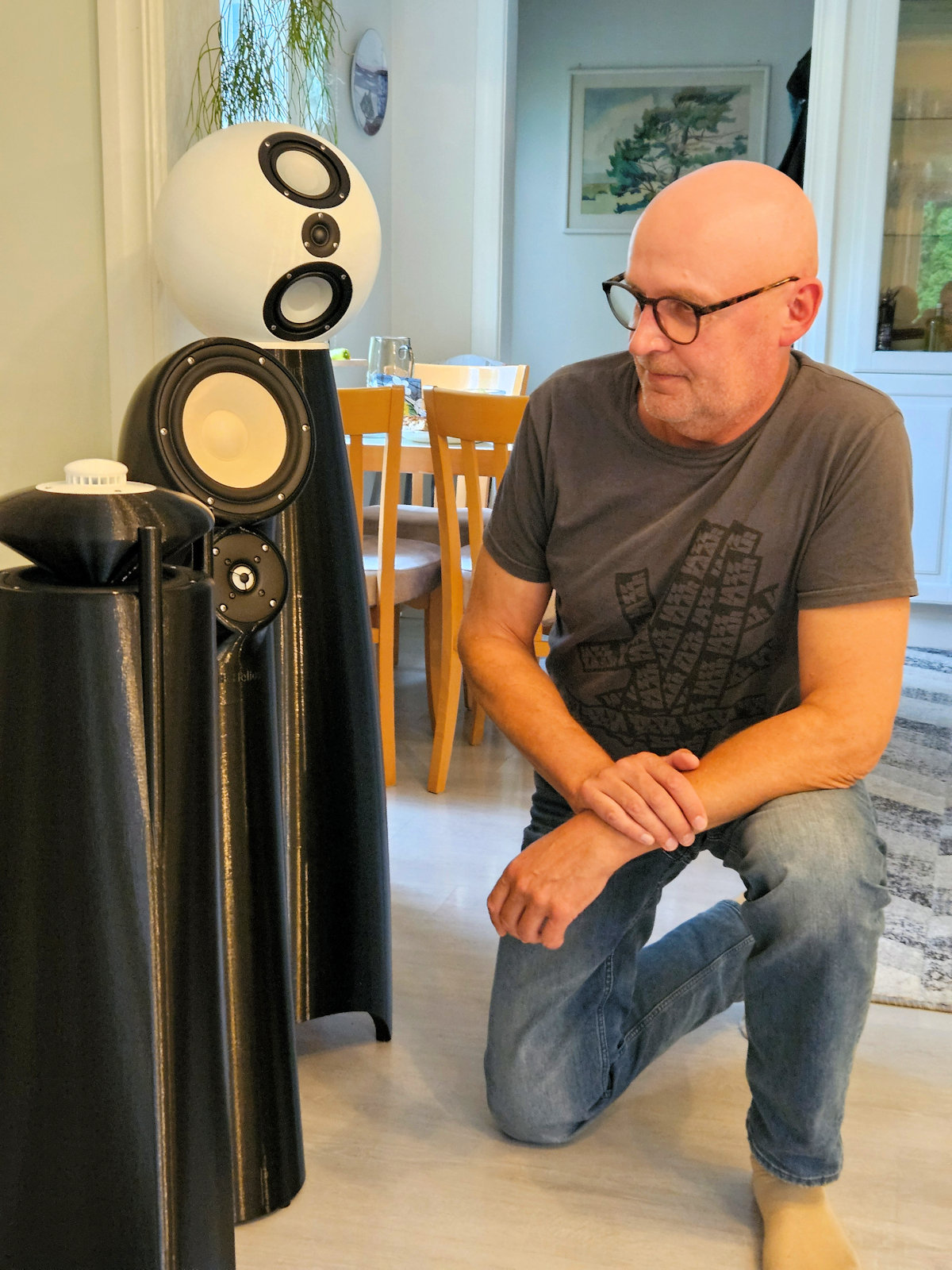
Juhan Tõhk evaluating the speakers: “Speakers need to be listened to thoroughly—from every direction, at every distance, at every height, and at every volume level.”

Klaverite Kants: Juhan Tõhk and Heli Mõttus
Audiophiles: Hamor Kaha and Sirje Kaha

 
Was this blog post helpful to you?
Leave a comment
Security code